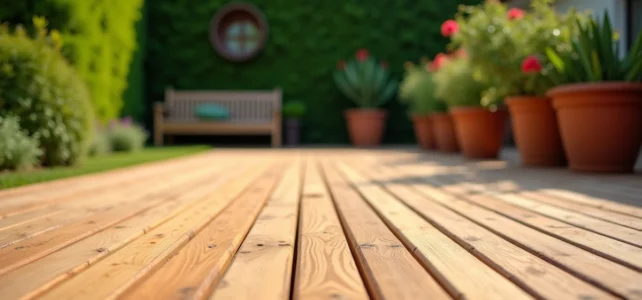
The employment class is not enough to predict the behavior of a decking board. Two species classified as 4 can age radically differently depending on their density, dimensional stability, and tannin content. Choosing the best wood for an outdoor terrace requires going beyond the simple standardized classification to delve into the mechanical properties of each species.
Dimensional stability and tannins: what really separates decking species
A decking wood undergoes constant wetting-drying cycles. The key data here is the radial and tangential shrinkage. The smaller the gap between these two values, the more the board remains flat over time.
Ipe and cumaru have a nearly identical ratio between radial and tangential shrinkage, which gives them remarkable stability. Softwoods like pine, even treated in autoclave class 4, show a more pronounced differential: the boards warp, twist, and the fastenings work harder.
The tannin content plays a often underestimated role. Tannins cause brown streaks on adjacent pavings and facades, especially in the first few months. Oak and chestnut are rich in tannins. Padauk releases an intense red pigment that can permanently stain light plaster. To know what is the best wood for an outdoor terrace, it is also necessary to plan a finishing detail (flashing, drip edge) at the base of walls when installing a species rich in extractives.
Autoclaved class 4 pine vs. thermo-treated pine: two impregnation logics
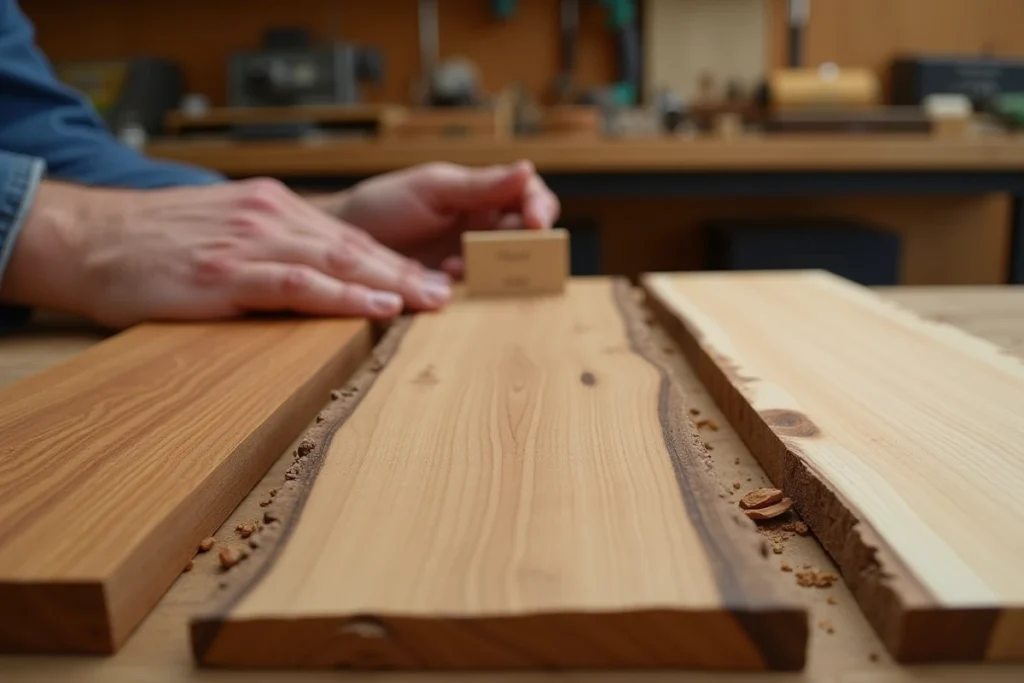
Class 4 autoclaved pine undergoes a chemical treatment under pressure that allows copper salts to penetrate the sapwood. The protection is effective against wood-destroying fungi and insects, but it does not alter the cellular structure of the wood. Autoclaved pine remains dimensionally unstable and requires regular maintenance to limit graying.
Thermo-treated pine (rectification or thermowood) undergoes prolonged heating between 180 and 230 °C in a controlled atmosphere. This process degrades the hemicelluloses, reduces hygroscopicity, and improves stability. The wood loses mechanical strength (reduced static bending), which requires a tighter joist spacing. However, no chemicals are used, making it the only truly bio-sourced option among treated softwoods.
Criteria for choosing between the two treatments
- Tight budget and installation on stable ground (concrete slab): class 4 autoclaved pine remains the best value for money, provided that annual maintenance with a saturator is accepted.
- Installation on pedestals or by the pool: thermo-treated pine limits the risk of deformation due to its low moisture uptake, a decisive advantage in areas exposed to water splashes.
- Environmental constraints or proximity to a vegetable garden: thermo-treated wood avoids any leaching of biocides into the soil, unlike copper-treated autoclaved wood.
Exotic wood decking and European regulation RDUE: anticipating price increases
The European regulation on deforestation (RDUE) will replace the RBUE at the end of 2026. Importers of exotic wood will need to prove that each batch does not come from deforested areas after 2020, with traceability enhanced by geolocation. For the most common tropical species used in decking (ipe, cumaru, padauk), a strain on supplies is already being felt.
Some exotic woods could become significantly more expensive or harder to source in the coming months. Distributors who have not anticipated compliance may face shortages. If you are planning a deck in ipe or cumaru, check that your supplier has up-to-date FSC or PEFC certification and has begun its RDUE compliance.
Credible alternatives to exotic wood
Densified bamboo (strand-woven) is gaining market share as an alternative to exotic wood. Its Brinell hardness exceeds that of most tropical hardwoods, and its rapid growth cycle gives it a more favorable carbon footprint. Robinia (false acacia), a European species naturally class 4, offers resistance comparable to cumaru with local sourcing. Its main drawback: board lengths rarely exceed two meters, which increases the number of end joints.
Composite decking boards: when wood is not the best answer
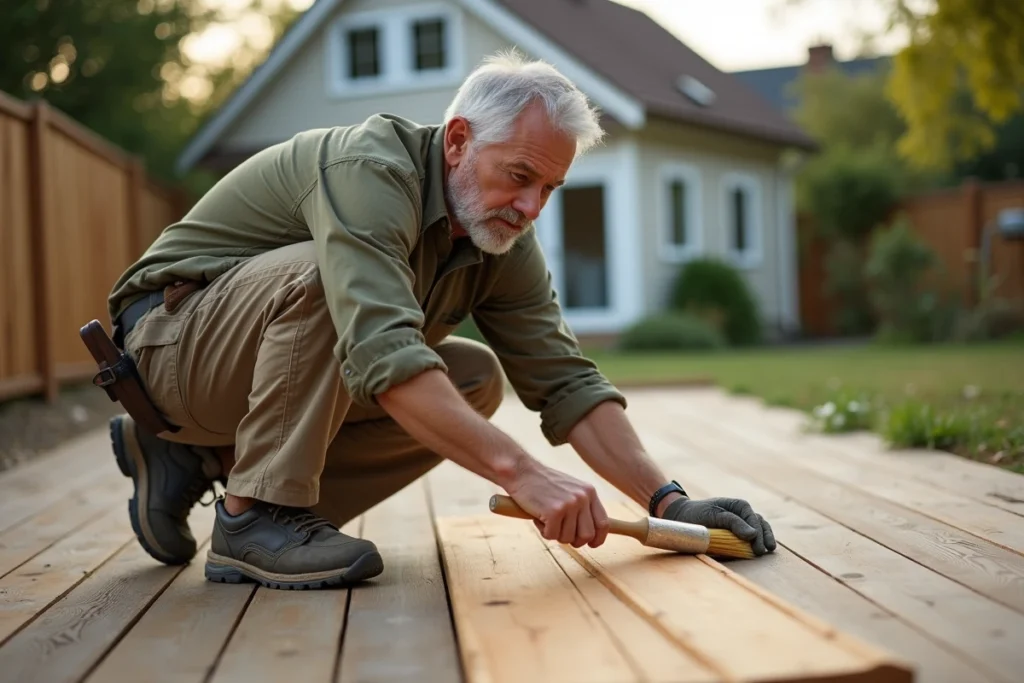
Composite (a mix of wood fibers and polymer) is not wood, but it deserves a place in the discussion. A next-generation co-extruded composite does not gray and requires no treatment. Its durability often exceeds that of treated softwoods. However, it heats up more in direct sunlight, and its smooth surface can become slippery when wet without an appropriate anti-slip profile.
The cost per square meter installed is similar to that of a mid-range exotic wood. The difference is seen in the long term: the absence of maintenance (no saturator, no brightener) more than compensates for the initial extra cost over a period of ten years or more.
- Frequent barefoot use (pool deck, south-facing terrace): be cautious of the surface temperature of the composite, which can significantly exceed that of natural wood in summer.
- Authentic wood aesthetic sought: the composite increasingly mimics grain patterns, but the feel remains plastic. Oiled natural wood retains a clear sensory advantage.
- Shaded and humid area: the composite resists moss and algae better than softwoods, but low-pressure cleaning is still necessary once a year.
The choice of a decking species hinges on three technical parameters: dimensional stability against water cycles, compatibility of the treatment with the immediate environment, and the supplier’s ability to guarantee traceability compliant with new European requirements. Asking the right question to the distributor about the origin and treatment is as important as comparing prices per square meter.