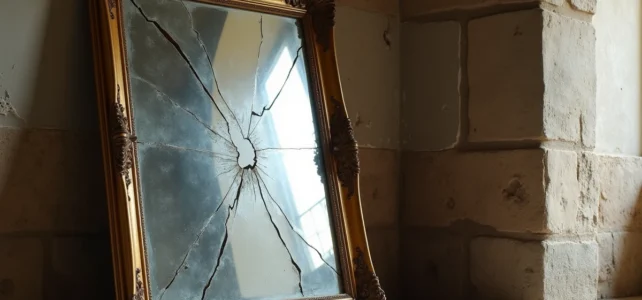
We gather the shards, we vacuum, and then the phrase comes, almost automatically: “seven years of bad luck.” Behind this verbal reflex lies a layering of ancient beliefs, psychological symbolism, and spiritual readings that have little to do with each other. The broken mirror does not have a single meaning: it has several, and they depend on the context in which one chooses to interpret the event.
Catoptromancy and the reflection of the soul: the ancient layer of the omen
Before being a bathroom object, the mirror served as a divinatory tool. The ancient Greeks practiced catoptromancy, the reading of the future in a mirror. If the surface broke during a consultation, the practitioner considered the oracle to be cursed. The reflection was not decorative: it was supposed to capture an image of the soul.
Under the Roman Empire, this idea hardened. The mirror reflected the soul as much as the face, and breaking the object meant degrading the soul itself. It is easier to understand why the superstition has endured through the centuries with such strength: touching the mirror was akin to touching the deep identity of the person.
The Romans also anchored the duration of the curse. The human body, according to their beliefs, renewed itself in cycles. The deterioration of the soul caused by a broken mirror therefore required a complete cycle to heal. The precise duration varies according to sources, but this is where the notion of a long period of bad luck associated with this domestic accident comes from.
This ancient layer explains why, in a broader analytical framework, the spiritual meaning of a broken mirror far exceeds the simple material accident.

Broken mirror and economic superstition in the Renaissance
We often talk about symbols and metaphysics, but the superstition of the broken mirror also has a very concrete origin. In Venice, during the Renaissance, glass mirrors were objects of considerable cost. Only wealthy families could afford them.
To protect these possessions, household masters instrumentalized popular belief. Threatening a servant with a curse was more effective than a simple fine. The superstition served as a disciplinary lever. The cost of replacement was such that a servant could lose several years’ wages.
This detail changes the reading of the omen. Part of the emotional weight that we still feel today when facing a broken mirror comes from an inherited social reflex, not from a metaphysical truth. Separating the two allows for a more discerning approach to the spiritual dimension.
Inner transformation: the contemporary spiritual reading
In contemporary and New Age spiritual currents, the broken mirror is subject to a complete reinterpretation. The event is no longer an omen of bad luck but a sign of the end of a cycle and energetic renewal. The central idea: what breaks is an old image of oneself, a fixed ego that no longer corresponds to the person in development.
This approach relies on the symbolism of the reflection. An intact mirror reflects a stable image. When it breaks, this stability shatters, along with the identity certainties that went with it. One then enters a phase of transformation, sometimes uncomfortable, but perceived as necessary.
What spiritual practitioners concretely propose
- Carefully gather the shards and wrap them in a dark cloth, an act interpreted as a symbolic closure of the old cycle
- Take time for introspection in the days that follow to identify what in one’s life needs renewal (relationship, habit, belief)
- Use sage or a purification ritual to mark the transition, a common practice in New Age circles to “cleanse” residual energy
Feedback varies on this point: some people report a real breakthrough after going through this exercise, while others see it as merely a symbolic gesture with no tangible effect. The approach remains subjective, but it has the merit of replacing fear with an active process.
Dreaming of a broken mirror: cross-cultural interpretations
The broken mirror is not limited to a physical accident. In a dream context, it carries distinct meanings depending on the cultural tradition referenced.
In many Islamic interpretations circulated online in recent years, dreaming of a broken mirror is associated with a moral warning. The symbol points to pride, self-illusion, or hypocrisy, and invites the dreamer to correct their behavior. We are far from the fatalism of “seven years of bad luck”: the dream functions as a signal for adjustment, not as a sentence.
From the perspective of spiritual psychology, the broken mirror in a dream is read as a metaphor for the fragmentation of the self. This type of image frequently appears in crisis journeys (burnout, grief, trauma). The intact mirror represents inner coherence; its fracture signals that this coherence is being tested.
These two readings, religious and psychological, converge on one point: the broken mirror in a dream does not herald an external catastrophe. It reflects an inner state that requires attention.

Superstition of the broken mirror: what to keep, what to discard
Not all beliefs are equal, and piling them up without sorting does no one any favors. What is worth keeping from the superstition of the broken mirror is the pause function it provokes. The accident stops the action, cuts the rhythm, and forces a moment of attention.
What deserves to be abandoned is the punitive dimension. The idea that a domestic accident could condemn someone to years of bad luck is based on mechanisms of social control, not on a coherent spiritual logic.
- Keep: the idea that the mirror symbolizes identity and that its fracture can invite self-reflection
- Keep: the reading of the end of a cycle, useful as a tool for introspection during a period of transition
- Discard: the superstitious fear inherited from an economic context (protection of Venetian mirrors) that has no relevance to our daily lives
- Discard: any fatalistic interpretation that robs the person of their capacity for action
The broken mirror remains an accident. But the way we choose to interpret it, between inherited panic and lucid introspection, says more about our relationship to beliefs than about the mirror itself. Cleaning up the glass shards is also an opportunity to sort out what we want to believe from what we endure by reflex.