
The Klarstein Maxfresh is presented as an evaporative air cooler, not an air conditioner. This distinction changes everything we can expect from the device in terms of performance, comfort, and usage conditions. This guide analyzes its measurable features to determine in which cases it lives up to its promises, and in which cases it is better to look elsewhere.
Klarstein Maxfresh Technical Specifications Compared to Portable Air Conditioners
The confusion between air coolers and portable air conditioners remains common. The table below contrasts the data of the Maxfresh with that of an entry-level portable air conditioner, to frame expectations above all else.
| Criterion | Klarstein Maxfresh | Portable Air Conditioner (entry-level) |
|---|---|---|
| Technology | Evaporation (water + ventilation) | Refrigerant compressor |
| Power | 65 W | 700 to 1,000 W |
| Water Tank | 6 liters | Not applicable (exhaust duct) |
| Weight | Less than 7 kg | 20 to 35 kg |
| Installation | None (portable device) | Exhaust duct to the outside required |
| Effect on Ambient Humidity | Increases humidity | Dehumidifies |
| Measurable Temperature Drop | Several localized degrees | Effective cooling of the room |
The Maxfresh consumes a fraction of the energy of an air conditioner. However, it does not produce cold in the thermodynamic sense. It blows air that has passed through a wet filter, which lowers the perceived temperature near the device.
To delve deeper into this point, a review of the Klarstein Maxfresh details the temperature and humidity measurements taken during a real-world test.
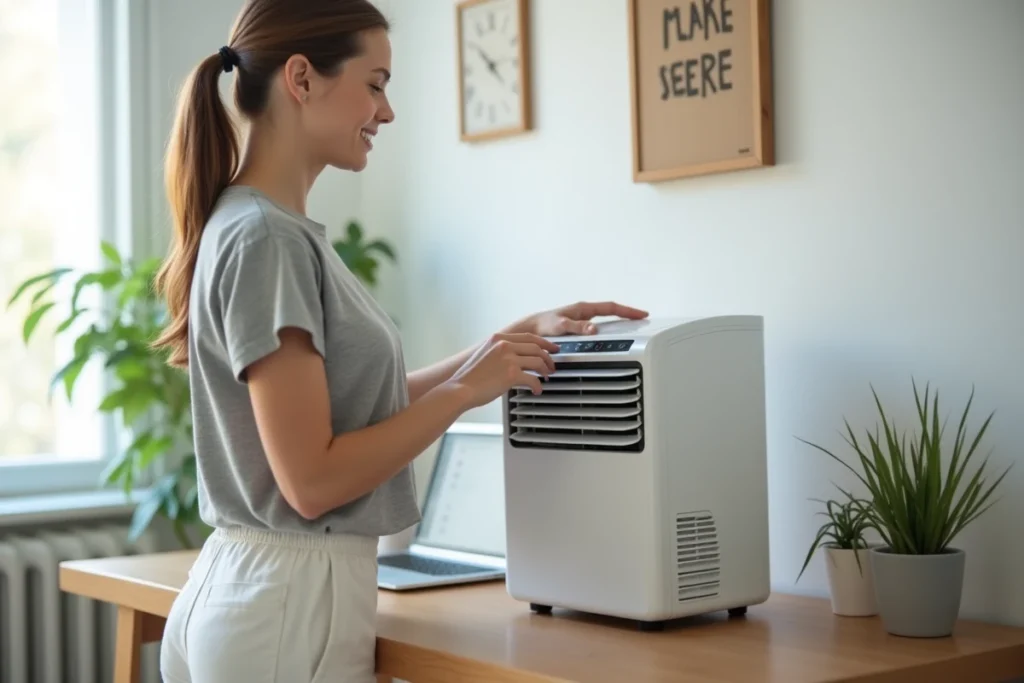
Humidity and Heatwave: The Real Weak Point of the Maxfresh Cooler
An air cooler works by evaporation. The water from the tank evaporates into the airflow, absorbing heat and cooling the area locally. The problem arises when the ambient air is already humid.
During a heatwave, the humidity level varies greatly depending on the region and the time of day. When the air is dry (continental climate, afternoon in the Mediterranean area), evaporation works properly and the feeling of coolness is noticeable. When the air is humid (night in coastal areas, imminent thunderstorm), the Maxfresh adds humidity to already saturated air.
In a small closed room, humidity can quickly rise above the comfort threshold. The device then blows warm and humid air, which degrades sleep quality instead of improving it. This is the structural limit of any evaporative cooler, not a flaw specific to the Maxfresh.
When the Maxfresh Remains Relevant
- In an office or studio with an open window, where air circulates and humidity does not stagnate
- For daytime supplemental use, directing a flow of cool air towards the face or upper body, for a few hours at a time
- In regions with dry heat, where the ambient humidity remains low even in summer
Conversely, in a poorly ventilated apartment or a closed room at night in a humid area, a conventional fan circulates air without adding water and is often more comfortable.
Ventilation Modes and Ergonomics of the Klarstein Maxfresh
The Maxfresh offers three power levels and three ventilation modes. The remote control allows for operating the device from a distance, which is important when it runs at night from the bedside table.
The timer is set in intervals. This is useful for programming an automatic shut-off after falling asleep, which also limits the accumulation of humidity in the room. This setting is the first practical lever to circumvent the problem mentioned earlier.
The airflow remains modest compared to a column fan of similar size. The Maxfresh is about 75 cm tall and 30 cm deep, a compact format that fits into a corner without taking up space. Its limited weight allows for easy movement from one room to another.
Noise Level: A Point to Watch
Several user feedback reports indicate a notable noise level at maximum power. At low speed, the device remains discreet. At high speed, the noise from the fan and the evaporation system can disturb light sleepers. Lowering the power and compensating with the timer remains the most common compromise.
Klarstein Maxfresh: For Which Buyer Profile
The Maxfresh does not replace an air conditioner. It is also not a simple fan. It sits between the two, offering an interesting value-for-money for those who accept its limitations.
- Buyer in a studio or room with a window: the cooler provides a real comfort gain if air circulates
- Person looking for a solution without installation or exhaust duct: the Maxfresh plugs in and works immediately
- Limited budget compared to the price of a portable air conditioner: the consumption of 65 W compared to several hundred for an air conditioner also affects the summer electricity bill
- User in a humid area without ventilation: the Maxfresh may worsen discomfort; a conventional fan would be more suitable
The question of the 6-liter tank also deserves attention. In continuous operation, the water runs out in a few hours. Regularly filling the tank is part of normal use, but it may surprise first-time users.
The Maxfresh is suitable for small ventilated spaces and dry heat. As soon as the ambient humidity rises or the room remains closed, its benefits fade. Keeping this criterion in mind at the time of purchase avoids the disappointment that fuels most negative reviews of this type of product.