
Proposing a family activity that truly works involves solving a concrete problem: engaging participants of very different ages, with incompatible motor skills and attention spans. Sharing unforgettable moments as a family is not just about choosing an outing from a catalog. The format of the activity, its duration, and its level of physical or cognitive engagement determine whether the memory will be positive or frustrating.
Family Activities by Age Group: Adapting the Format Rather than the Theme
Most lists of ideas offer activities without specifying who they are suitable for. An escape room captivates a nine-year-old, but puts a toddler in difficulty. Conversely, a motor skills course in the garden bores a teenager within minutes.
For children under three, the report from the expert commission submitted on April 30, 2024, recommends no screen time and a heavily limited use until the age of six. This framework points towards short sensory activities: free play, shared reading, nature observation. Sessions should not exceed twenty to thirty minutes before attention wanes.
Between the ages of three and six, creative workshops work as long as a visible result is expected quickly. Collective painting on a large format, modeling, assembling recycled materials. The immediate gratification of the result maintains involvement.
For those over seven, we recommend formats that introduce a narrative challenge. Treasure hunts remain a classic, but their enriched version (a neighborhood investigation with photographic clues, puzzles to solve on a marked route) generates much higher engagement. Teenagers participate if they have an active role in the design or moderation, not if they are subjected to an activity designed for younger children.
This age-based division does not prohibit mixing groups. It requires planning differentiated roles within the same activity, which changes the preparation logic.
Screen-Free Group Games: Building a Lasting Family Ritual
Among family experiences on Gazette Debout, several formats reappear as reliable values precisely because they are repeated. The strongest memories do not come from an exceptional outing, but from a recurring appointment that every family member looks forward to.
The weekly themed meal is a good example. Each week, a family member chooses the menu, table decoration, and music. The effort of preparation remains modest, but the rotation creates a sense of belonging. Children who cook also develop concrete autonomy.
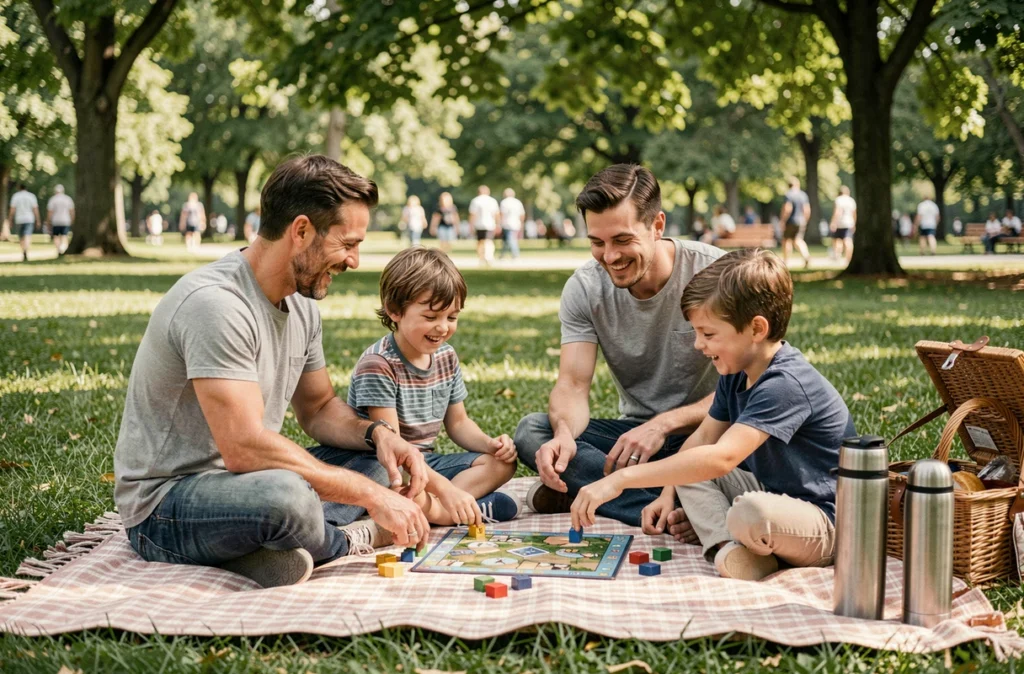
Game nights deserve a more structured approach than one might think. Alternating between cooperative and competitive games prevents boredom. Cooperative games (solving a challenge together against the board) are better suited for families with young children, as they eliminate the frustration of losing.
- Cooperative games for ages 4-7: favor games lasting less than twenty minutes with simple visual mechanics
- Investigation or puzzle games for ages 8-12: tabletop escape room formats work well in mixed families
- Light strategy games for teenagers and adults: introduce a handicap system to balance levels
A family ritual works when it is short enough not to be burdensome and regular enough to become a reference point. Two hours on Sunday is sufficient.
Creative Workshops and Intergenerational Projects at Home
The intergenerational project is the most underestimated format. Involving grandparents, parents, and children in the same endeavor creates interactions that no park outing can generate. Each generation brings a different skill.
A physical photo album built together is the most accessible illustration of this. Grandparents tell stories, parents organize, children paste and decorate. The result becomes a transmission object. This type of project can be divided into short sessions spread over several weeks, making it compatible with busy schedules.
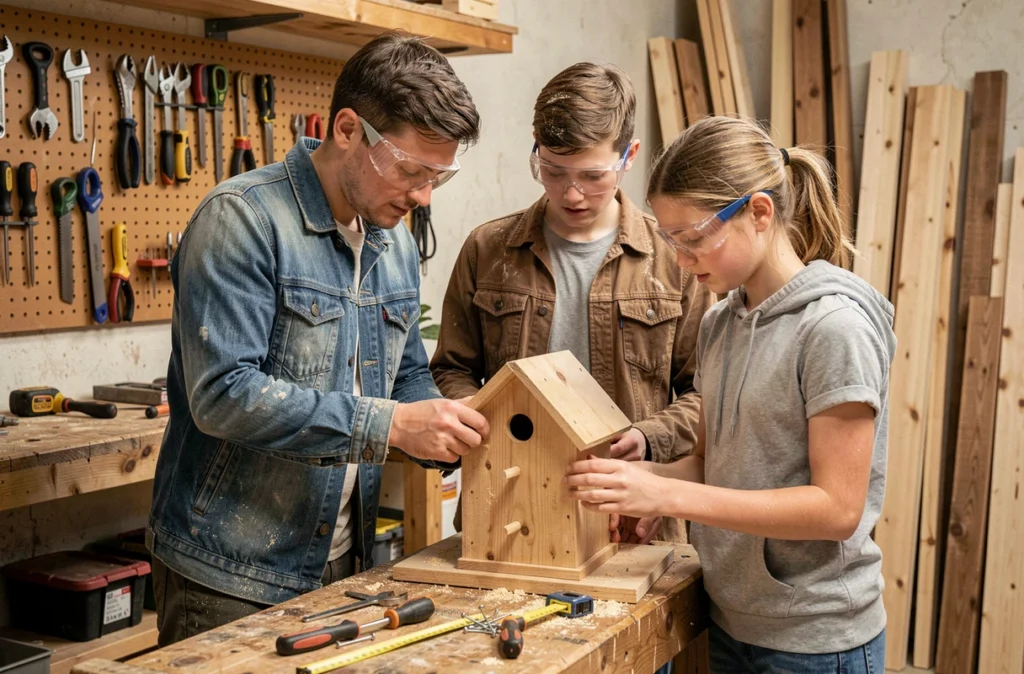
Shared hands-on workshops (simple woodworking, sewing, air-dry pottery) have a structural advantage: they produce a concrete object that anchors the memory. A child who uses an object made with their parents in daily life maintains a tangible connection to the moment experienced.
We observe that families who document their projects (photos of progress, a logbook kept by the children) prolong the duration of the memory. The documentation process itself becomes a shared activity.
Cultural Outings with Family: Going Beyond the Classic Visit
A trip to the museum or a show works under one condition: it must be prepared in advance with the children. Choosing the exhibition together, researching information on the theme, assigning each child an observation mission transforms a passive visit into an active exploration.
- Give each child a disposable camera with the instruction to capture three details that surprise them
- Prepare a fun little questionnaire adapted to the exhibition (not a school-style multiple-choice, but rather visual riddles)
- Plan a discussion time after the visit, in a café or on a bench, for everyone to share their favorite discovery
Municipal libraries and media libraries regularly offer free activities on weekends. These short formats (storytelling, illustration workshop, screening followed by a discussion) easily fit into a day without requiring a significant budget.
The quality of the moment depends more on the preparation than on the chosen location. A walk in the forest with a specific goal (identifying five species of trees, collecting items for a natural collage) surpasses a trip to an amusement park where everyone endures the waiting line.
Micro-Adventures Close to Home: The Staycation Without Traveling Far
The concept of micro-adventure applied to family relies on a simple principle: reproducing the conditions of a trip (change of scenery, discovery, challenge) within a limited perimeter. Camping in the garden, a night hike with headlamps, a sunrise picnic in a municipal park.
The change of scenery comes from the time or sensory shift, not from the distance traveled. Sleeping in a tent twenty meters from home remains an adventure for a five-year-old. Walking in a familiar woods at dusk completely changes the perception of the place.
These formats present a significant logistical advantage: in case of unforeseen circumstances (fatigue of a toddler, unfavorable weather), retreat is immediate. This security allows for trying more ambitious formats without real risk and adjusting the duration of the activity in real-time to the group’s energy.
Shared family moments that leave a lasting mark rarely have a high cost or complex logistics. They rely on three elements: a format suitable for all present ages, regularity that creates anticipation, and a slight deviation from the everyday that transforms the ordinary into a memory.