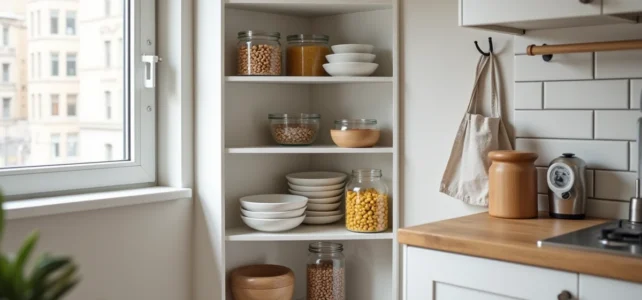
A poorly chosen corner cabinet turns a kitchen corner into a dead zone. The problem does not stem from a lack of space, but from a layout error: the actual geometry of the corner was not measured before ordering the cabinet. We regularly see pull-out baskets delivered for a right angle when the wall forms a beveled edge, which blocks the opening or leaves an unusable gap of several centimeters.
Geometry of the Corner and Cabinet Choice: The Decision That Determines All Storage
Before browsing accessory catalogs, the corner must be qualified. A strictly right angle accepts classic circular carousels and 360° rotating trays. A beveled corner (common in older buildings or kitchens with a chimney flue) requires a trapezoidal cabinet and half-moon trays or side-opening drawers.
We recommend measuring the angle with a protractor or laser before placing any orders. A deviation of just a few degrees from 90° is enough to create a conflict between the cabinet door and the return of the countertop. This layout constraint must be decided before installation, not after.
To explore storage configurations suitable for each type of corner, the Angie Sweet Home website details solutions based on the actual shape of the corner.
Activity Triangle and Placement of the Corner Cabinet in a Small Kitchen
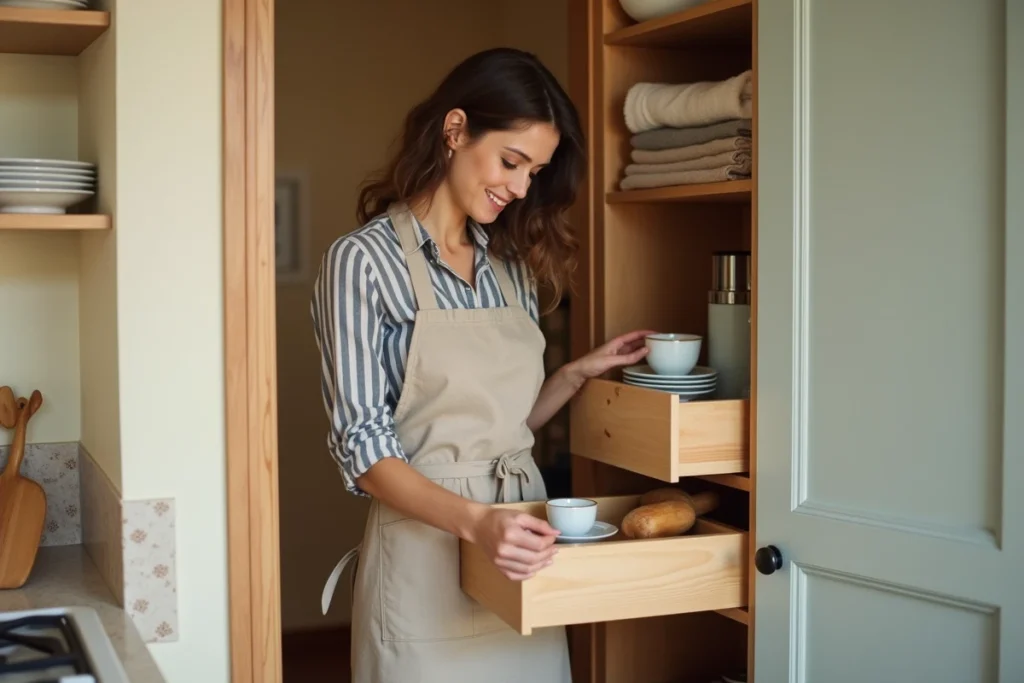
Consumer articles present the corner cabinet as a simple storage receptacle. In reality, its position relative to the cooking surface determines the ergonomics of the entire kitchen. A custom layout guide recommends placing the corner cabinet immediately to the left or right of the cooking area. The goal: to minimize movement between storage (pots, spices, oils) and the main work station.
In a small L-shaped kitchen, the activity triangle (cooking, washing, storage) is compressed. If the corner cabinet is located opposite the cooking surface, the storage gain is negated by the loss of fluidity. Placing heavy and frequently used utensils in the corner near the cooktop reduces trips back and forth and avoids cluttering the countertop.
Circulation Between Opposing Cabinets: The Trap of Small Kitchens
A rarely discussed point concerns opening conflicts in tight spaces. When two rows of cabinets face each other, the passage space must allow for the simultaneous opening of a drawer and a corner door. Below a certain clearance, the drawers of the corner cabinet do not fully extend or block against the opposing cabinet.
We observe that this problem often only appears after installation. The solution: simulate the maximum opening of the chosen system (pull-out basket, carousel, diagonal drawer) taking into account the actual space, with the door open.
High or Low Corner Cabinet: Decide Based on Frequency of Use
The high corner cabinet with rotating shelves is appealing for its storage volume. It is suitable for lightweight and infrequently used items (cake molds, serving dishes). On the other hand, a low corner cabinet with a pull-out basket remains the most functional choice for everyday utensils, as it puts the contents within easy reach without a stool or effort.
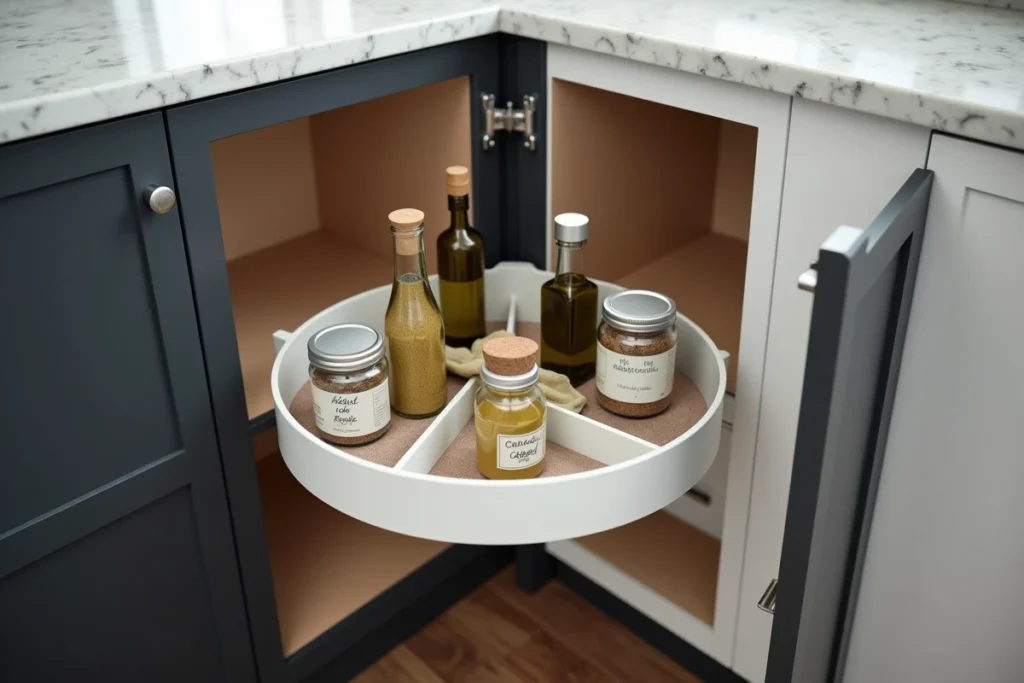
- Circular tray carousel: suitable for right angles, quick access but limited capacity due to the round shape in a square cabinet.
- “Magic corner” pull-out basket: maximizes usable volume by pulling out two levels of baskets from the cabinet. Requires a right angle and sufficient cabinet depth.
- Half-moon shelves: a compromise for beveled corners, partial access but good use of trapezoidal volume.
- Diagonal drawer (or angled drawer): a compact solution for narrow corners, a drawer oriented at 45° that slides towards the user.
The choice also depends on the expected weight. A carousel does not handle stacks of cast iron pans well. Pull-out baskets on rolling rails better accommodate heavy loads.
Corner Countertop: Materials and Junction
In a small kitchen, the corner countertop provides an additional surface that is often underestimated. The junction between the two sections of the countertop is a critical point. A poorly sealed joint allows water to seep in, causing laminate to swell or solid wood to darken.
The corner junction must be treated with a sealant suitable for the material. On laminate, a waterproof edge band and an aluminum junction profile protect the cut. On a resin or sintered stone countertop, a 45° glued assembly allows for an almost continuous surface without a visible joint.
Depth of the Corner Countertop
The standard depth of 60 cm can be reduced on one of the two sections to free up passage in a very narrow kitchen. This asymmetry requires a custom corner cabinet, but it resolves the circulation conflicts mentioned earlier. We recommend it when the clearance between opposing cabinets is too tight for a standard pull-out system.
A slightly thinner countertop on the secondary section also allows for wall space for a functional backsplash (magnetic bar, narrow open shelf) that compensates for the loss of storage surface.
The corner cabinet in a small kitchen is not a supplementary accessory. It is the piece that structures the ergonomics of the entire room. Measuring the actual angle, checking opening clearances, positioning the cabinet in relation to the activity triangle: these three decisions made in advance avoid most design errors we see in compact kitchens.