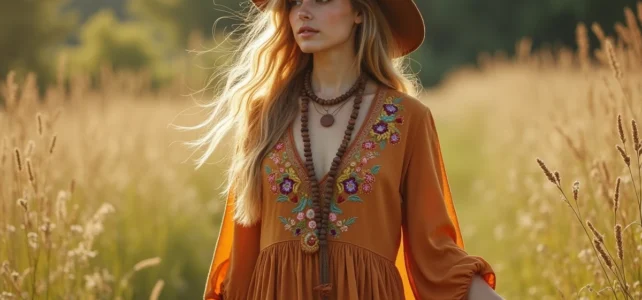
The return of the 70’s women’s hippie look in 2026 is not just about slipping on a long floral dress. The current trend is based on a precise shift in materials and a silhouette construction that distinguishes controlled bohemian chic from approximate vintage costume.
Raw fibers and textile choices for a sustainable 70’s women’s hippie look
The major shift of the 2026 season concerns materials. Bohemian dresses and tunics made of viscose or polyester, which have been ubiquitous in recent years, are giving way to three fibers: linen, hemp, and silk. This trio imposes a drape, a touch, and a hold that synthetics cannot replicate.
Linen offers a natural crinkle that contributes to the relaxed aesthetic of the 70’s style. Hemp, being more durable, supports plant dyes without losing its flexibility. Silk, reserved for dressier pieces (bell sleeve blouses, headscarves), provides the necessary fluidity for voluminous shapes.
We recommend checking the composition on the label before any purchase. A dress labeled “bohemian” but made of more than half polyester will not age in the same way. To explore the 70’s women’s hippie look on Zaza Mode, the selection focuses precisely on these pieces made from natural fibers.
This textile choice is not insignificant in the context of French regulations. The law against ultra-fast fashion, definitively adopted by Parliament, will increase the cost of low-cost imported bohemian pieces starting September 1, 2026. Investing in higher quality raw fibers is also becoming an economic calculation, not just an aesthetic gesture.
Bohemian chic silhouette construction: volumes, proportions, and common mistakes
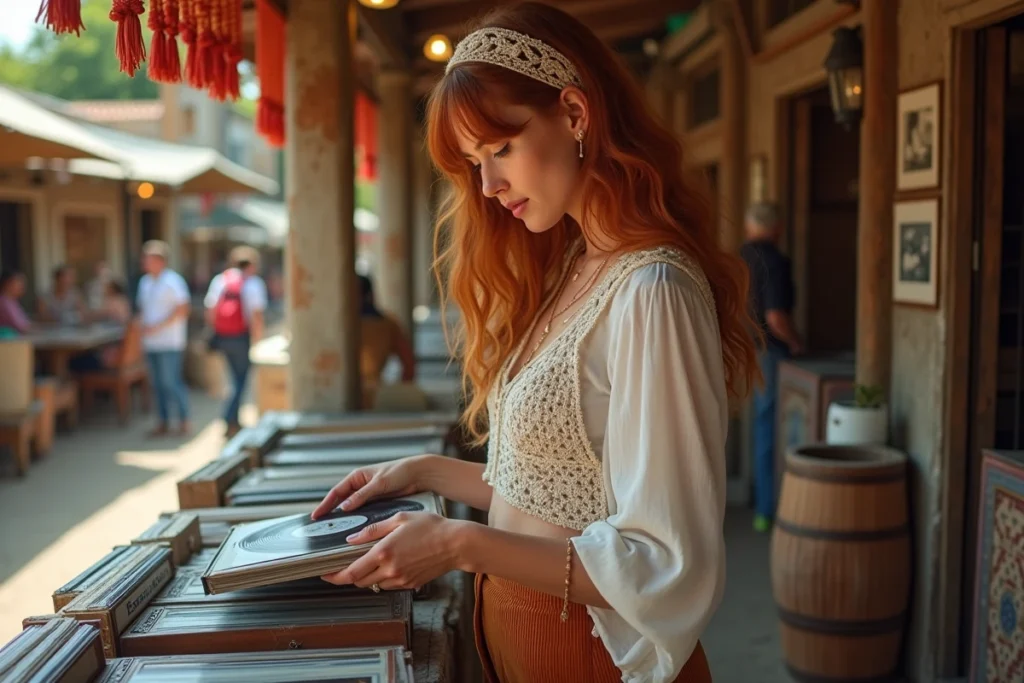
The 70’s hippie style relies on a play of asymmetrical volumes. The technical rule we observe in successful silhouettes: only one loose volume per outfit, never two. A flowing long dress is worn with a belt that cinches the waist. A flared pant is paired with a fitted or semi-fitted top.
The most common mistake is layering loose pieces all over the body. The result flattens the silhouette instead of freeing it. The bohemian chic of the 70’s was structured by anchor points: defined waist, exposed shoulders, or a defined neckline.
Structuring pieces to prioritize
- The braided leather belt, worn high on a maxi dress or tunic, recreates the waistline without rigidity
- The suede or faux suede vest (sleeveless, mid-thigh length) channels the volume of a loose blouse while adding a textured layer
- The high-waisted flared jeans in raw denim, which anchors the bottom of the silhouette and supports fluid tops in linen or silk
Layering remains a strong code of the hippie style, but it should be done with thin layers. A lightweight cotton kimono over a basic tank top, for example, adds movement without bulk.
Color palette and patterns: beyond the floral cliché
Floral prints remain a staple, but bohemian chic 2026 expands the palette. Earthy tones, rust, mustard, and burgundy dominate the collections, in contrast to pastels that lean more towards cottage style.
Ethnic patterns (ikat, paisley, batik) work better on unique pieces than on a total look. A long batik skirt worn with a solid cream linen top creates a contrast that highlights the pattern. Multiplying prints in the same outfit has the opposite effect: the eye doesn’t know where to settle.
Tie-dye, a signature of the seventies, returns in a more subtle form. We observe tone-on-tone gradients (terracotta to sand, indigo to off-white) rather than the multicolored spirals associated with festival costumes.
Leather accessories and artisanal jewelry: what distinguishes bohemian chic from generic boho
Accessories tip an outfit towards “chic” or “costume.” The difference lies in two criteria: material and moderation.
Vegetable-tanned leather (fringe bags, strappy sandals, wide belts) brings a patina that faux leather cannot replicate. Fringes, emblematic of hippie attire, gain elegance on genuine leather. On synthetic materials, they fall flat and mark the garment as disposable.
Jewelry: the rule of single metal
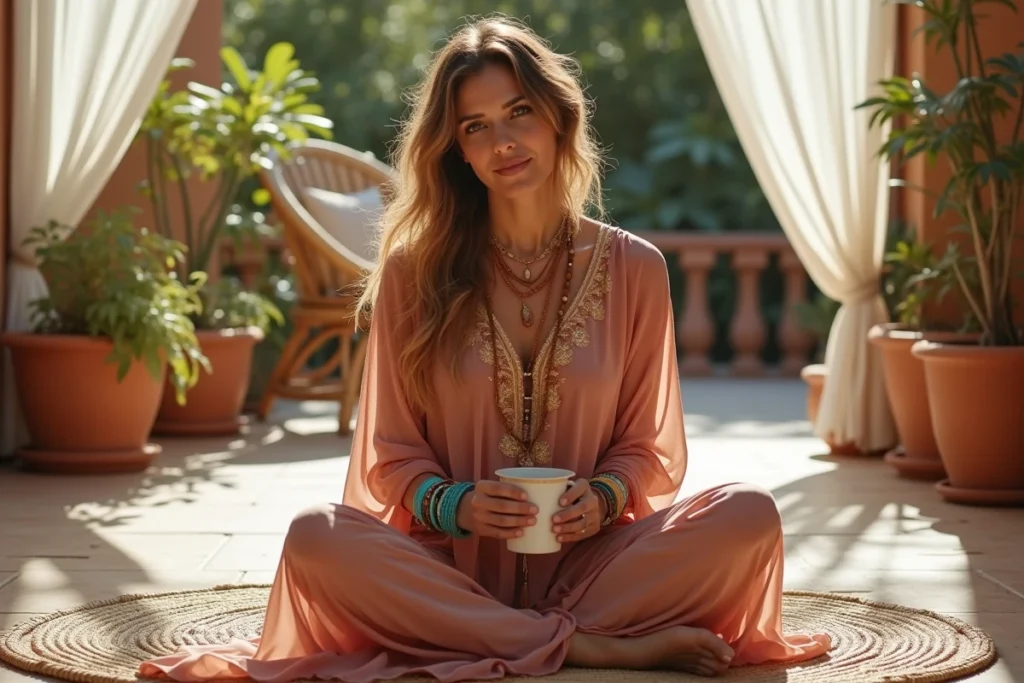
Wearing a single metal per outfit unifies all accessories. Aged silver, brass, or bronze suits the 70’s spirit better than shiny gold. Handmade jewelry with natural stones (turquoise, carnelian, agate) adds an ethnic touch without overwhelming.
- Wide hammered silver rings, worn on one or two fingers maximum, avoid the accumulation that muddles the style
- Dangling metal earrings replace basic hoops and add movement
- Long necklaces with a single pendant (feather, stone, locket) are worn over a bare neckline, never over a high collar
The wide-brimmed hat in felt or straw remains a strong marker of the bohemian chic style. Its function goes beyond a simple accessory: it structures the silhouette from above and visually anchors the outfit.
The well-executed 70’s women’s hippie style relies on precise material choices, rigorous volume management, and restraint in accumulation. Raw fibers, earthy palettes, and genuine leather accessories form a more sustainable foundation than low-cost synthetic pieces, especially in a French textile market undergoing regulatory transformation.