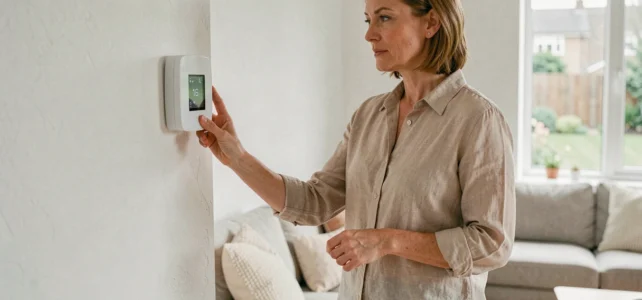
Your living room stays cold despite the heating running, or your bedroom becomes stifling as soon as the first days of heat arrive. These situations indicate an equipment problem, not just a lack of will. Choosing the right equipment for the comfort of your home requires understanding how heat circulates, how air is renewed, and which devices truly deserve your budget, especially in a rapidly evolving regulatory context.
Regulation 2026 and Equipment Choices: What Changes Really
Before comparing products, it is essential to know what financial aid still covers what. Since the summer of 2026, the government has refocused MaPrimeRénov’ and energy savings certificates on so-called “major renovations.” Aid for isolated gestures (single windows, single VMC, single wood stove) is gradually being excluded.
The most notable change concerns heating. Starting September 1, 2026, major renovation operations in individual homes (CEE BAR-TH-174 and BAR-TH-175 sheets) must lead to the absence of fossil fuel consumption for heating and domestic hot water. In practical terms, if you undertake a subsidized renovation, you will no longer be able to keep a gas boiler.
This framework directs the choice towards efficient electric equipment: heat pumps, decarbonized hybrid systems, thermodynamic water heaters. Rather than reasoning equipment by equipment, the logic becomes holistic. A complete catalog of home equipment on Mon Habitat allows you to visualize this approach by categories before consulting a craftsman.
Thermal Comfort in Winter: Heat Pump or Inertia Radiator
You may have noticed that some rooms remain pleasant even when the heating stops, while others cool down in just a few minutes? The difference lies in the type of heat emitted.
Convection or Radiant Heat
A classic convector heats the air. Warm air rises, cold air descends, and you feel unpleasant drafts near the floor. An inertia radiator (cast iron, ceramic, lava stone) stores heat in its mass and releases it through radiation. The temperature remains more uniform in the room, even after the device stops.
The air-water heat pump operates differently. It captures the calories present in the outside air to heat a water circuit that supplies radiators or underfloor heating. Its efficiency far exceeds that of a conventional electric radiator, significantly reducing the energy bill.
Which System to Favor According to Your Home
An apartment in a condominium does not always allow for the installation of an external heat pump unit. Inertia radiators, controllable by a connected thermostat, then represent a coherent alternative. In an individual house, the air-water heat pump coupled with underfloor heating offers the best thermal comfort, provided that the insulation is adequate.
The point of caution: installing a heat pump in a poorly insulated home amounts to heating the outside. Insulation always comes first.
Insulation and Windows: The Two Areas That Condition Everything Else
Why start there? Because no heating or cooling equipment can compensate for a failing thermal envelope. Investing in a high-performance device without addressing insulation is like filling a bathtub with the drain open.
- Attics and Roof: Heat rises, and it escapes most through the roof. Insulation with rock wool or cellulose wadding in lost attics remains the intervention with the best cost-effectiveness ratio.
- Double or Triple Glazing Windows: Reinforced insulation double glazing (VIR) reduces heat loss through glazed surfaces and eliminates the sensation of cold walls. Triple glazing is mainly justified on north-facing facades or in regions with harsh winters.
- Walls and Thermal Bridges: External insulation (ITE) eliminates thermal bridges at wall-floor junctions. Internal insulation is cheaper but reduces living space and does not address these thermal bridges.
These three areas, treated together in a major renovation, are those that the new aids still fund in 2026. Treating them separately, gesture by gesture, becomes more challenging to finance with public schemes.

Ventilation and Indoor Air Quality: The Often Overlooked Aspect
A well-insulated house but poorly ventilated accumulates humidity, indoor pollutants, and CO2. Comfort is not just about temperature: the quality of the air you breathe matters as much as the warmth felt.
The single-flow VMC extracts stale air from humid rooms (kitchen, bathroom) and allows fresh air to enter through air inlets on the windows. It is inexpensive, but it brings in cold air in winter, which increases heating needs.
The double-flow VMC with heat recovery solves this problem. It preheats incoming air using the heat from outgoing air. The comfort gain is immediate: no more cold drafts, more stable temperature, and reduced heating bills. Its installation cost is higher, but within the framework of a comprehensive renovation, it fits into the aided pathway.
Summer Comfort Without Air Conditioning: Shutters, Ventilation, and Thermal Inertia
With increasingly hot summers, the temptation for air conditioning is strong. A few well-chosen devices can allow you to do without it in many configurations.
External shutters or adjustable sunshades block solar radiation before it passes through the glazing. An interior shade, on the other hand, lets heat in and then tries to contain it: this is much less effective. The temperature difference felt between an external shutter and an interior curtain can be striking.
Natural night ventilation works well when the architecture allows it. Opening opposite windows at night creates a draft that evacuates the heat accumulated in the walls and slabs. This is the principle of thermal inertia: heavy materials (concrete, stone, brick) absorb the coolness of the night and release it during the day.
Combining window screens with this strategy allows for nighttime ventilation without suffering from insects, a practical detail that truly changes usage.
The choice of equipment for domestic comfort is no longer made product by product. Regulations push towards comprehensive renovations, and this is coherent: insulation, decarbonized heating, efficient ventilation, and solar protection form a system. Addressing a single link without the others limits results and complicates access to aid. Starting with an energy diagnosis remains the first concrete step before any purchase.