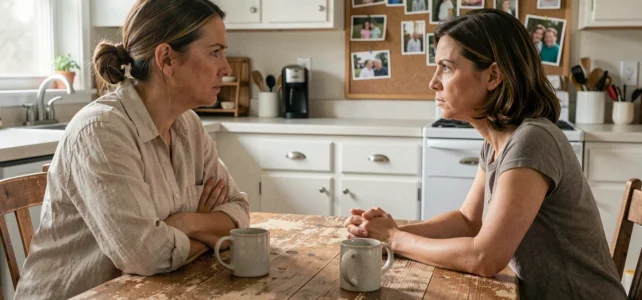
Little Fires Everywhere, aired in 2020 on Hulu with Reese Witherspoon and Kerry Washington, left a lasting impression with its exploration of racial and social tensions in an apparently peaceful American suburb. The series adapted Celeste Ng’s novel and wrapped up its storyline in eight episodes. Since then, no announcement for a season 2 has been made, and the reasons are tied both to the nature of the project and to an underlying trend in the television industry.
Limited Series: A Narrative Format That Excludes Continuation
Little Fires Everywhere was conceived from the start as a limited series with a closed narrative arc. The main storyline, centered on the conflict between Elena Richardson and Mia Warren, finds its resolution in the final episode. The fire at the Richardson house, Izzy’s departure, and the dispersal of the characters close every narrative thread opened throughout the eight episodes.
Celeste Ng’s novel ends even more definitively than the series, with a sentence that propels Elena into an endless quest to find her daughter. The series slightly opened this ending, but without leaving a true narrative door for continuation. The creators had a unique source material, and it has been fully adapted.
Several press analyses remind us that the main plot is already resolved by the end of the first season. Liz Tigelaar, the showrunner, approached the project as a closed entity. Without additional novelistic material and without a creative desire to invent a sequel, the very basis for a season 2 does not exist. For those seeking information on season 2 of Little Fires Everywhere, this observation remains central.

Reese Witherspoon, Kerry Washington, and Casting Constraints
Beyond the script, the casting plays a decisive role in the practical impossibility of a sequel. Reese Witherspoon and Kerry Washington are both lead actresses and producers of the project. Their respective schedules have become significantly busier since 2020.
Witherspoon runs her production company Hello Sunshine, involved in numerous projects for different platforms. Washington is busy with roles in film and television. Bringing these two actress-producers together for a new season would require a logistical alignment that has never been seriously considered.
The issue is not just about availability. In limited series productions, the willingness of the creators and leads to continue is the decisive factor. None of the stakeholders has publicly expressed a desire to reprise these characters. This absence of signal is, in itself, an answer.
Profitability of Limited Series on Streaming Platforms
Platforms evaluate the renewal of a series based on several criteria: completion rate, impact on new subscriptions, production cost relative to audience. A series may have found its audience without justifying an additional season economically.
Little Fires Everywhere generated strong critical and media engagement during its airing. Field feedback varies on whether this engagement translated into long-term subscriber retention. Hulu has never disclosed specific figures on the series’ performance in terms of subscriptions.
The economic calculation of platforms sometimes favors the production of new original content rather than extending existing projects. A completed limited series remains a permanent catalog asset, accessible to new subscribers without requiring additional investment.
What Platforms Gain by Not Renewing
- A finished product in the catalog that attracts new viewers without additional production costs
- The possibility to reinvest the budget into a new original project with higher media buzz potential
- The absence of risk of qualitative dilution, which could tarnish the reputation of a critically acclaimed first season
Why Closed Limited Series Are Being Revalued by the Public
Little Fires Everywhere fits into a broader trend. Limited series designed as complete narrative objects rather than franchises are gaining prestige among the public and professionals. Productions like Chernobyl, When They See Us, or Unorthodox have demonstrated that a limited narrative can leave a lasting mark on popular culture without requiring extension.
This phenomenon responds to an identifiable fatigue among viewers. The proliferation of seasons on streaming platforms creates a sense of obligation: one must follow, catch up, commit for several years. The limited series offers a complete experience in just a few hours, aligning with current consumption habits.
The available data do not allow us to conclude that limited series systematically outperform long series in terms of audience. However, their completion rate tends to be higher, precisely because the viewer knows they will not have to commit beyond one season.

Prestige as a Catalog Strategy
For platforms, an acclaimed limited series functions as a permanent draw. It does not age in the same way as a long series whose quality may fluctuate over the seasons. Little Fires Everywhere retains its thematic relevance, with its questions about racial privilege and motherhood remaining current.
This logic explains why some platforms are now encouraging creators to propose closed narratives. The model of the extended franchise, inherited from traditional television, is gradually giving way to standalone narratives.
Little Fires Everywhere: A Story That Stands on Its Own
The final episode leaves each character at a crossroads. Elena must face the consequences of her choices. Mia hits the road with Pearl. The Richardson children each bear a part of the responsibility for the fire. This dispersal is not a cliffhanger; it is a deliberate full stop.
Extending this narrative would require inventing new conflicts for characters whose arcs are complete. Forced sequel attempts in the television industry rarely yield satisfactory results. Big Little Lies, another production led by Reese Witherspoon, illustrates this risk: its season 2, although supported by an outstanding cast, was perceived as less necessary than the first.
Little Fires Everywhere will likely remain what it was always designed to be: a limited series in eight episodes, closed and complete. Its lack of a season 2 is not a shortcoming. It is a sign that a narrative can end without leaving the door open, and that this closure is part of its value.