You progress in running, swimming, or weight training, and then one day, for no apparent reason, your times stagnate. Pain sets in. Energy is lacking. The problem doesn’t always stem from the training volume. It often comes from a lack of information about your own body. The sports physical assessment serves precisely to fill this blind spot.
What a field test reveals that training alone does not show
Have you ever noticed that the same program yields very different results from one person to another? Two runners follow the same plan for twelve weeks. One gains speed, while the other injures their knee. The difference rarely lies in motivation.
A sports physical assessment measures parameters that subjective feelings do not capture. For example, a muscular imbalance between quadriceps and hamstrings can go unnoticed for months. It only manifests when the load increases, in the form of tendonitis or joint pain.
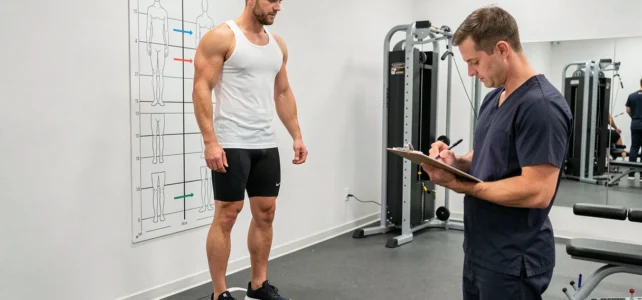
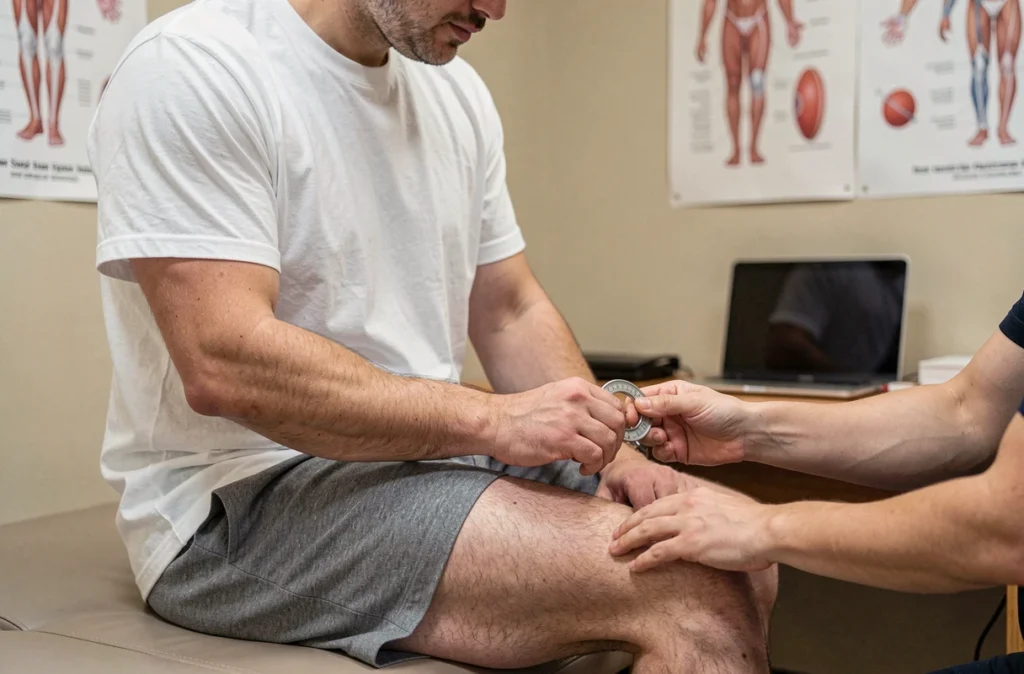
Field tests also evaluate the quality of movement. An asymmetrical stance during the stride, excessive rotation of the pelvis, an ankle compensating for a hip mobility deficit: these motor patterns develop without you realizing it. The assessment makes them visible, measurable, and correctable. To conduct a sports physical assessment that leads to concrete adjustments, it is necessary to combine postural analysis, joint mobility evaluation, and strength tests specific to your discipline.
This preparatory work changes the training logic. Instead of following a generic plan, you identify your actual weaknesses and correct them before they become injuries.
Sports assessment and injury prevention: the neuromuscular link
Injury prevention is not limited to warming up and stretching. It relies on a precise mechanism that specialists call neuromuscular control. In simple terms, it is your brain’s ability to activate the right muscles, at the right time, with the right intensity.
Let’s take a concrete example. During a landing from a jump, the knee must remain aligned with the foot. If the stabilizing muscles (notably the gluteus medius) contract too late or too weakly, the knee moves inward. Repeat this pattern hundreds of times a week, and you develop a pathology of the cruciate ligament or cartilage.
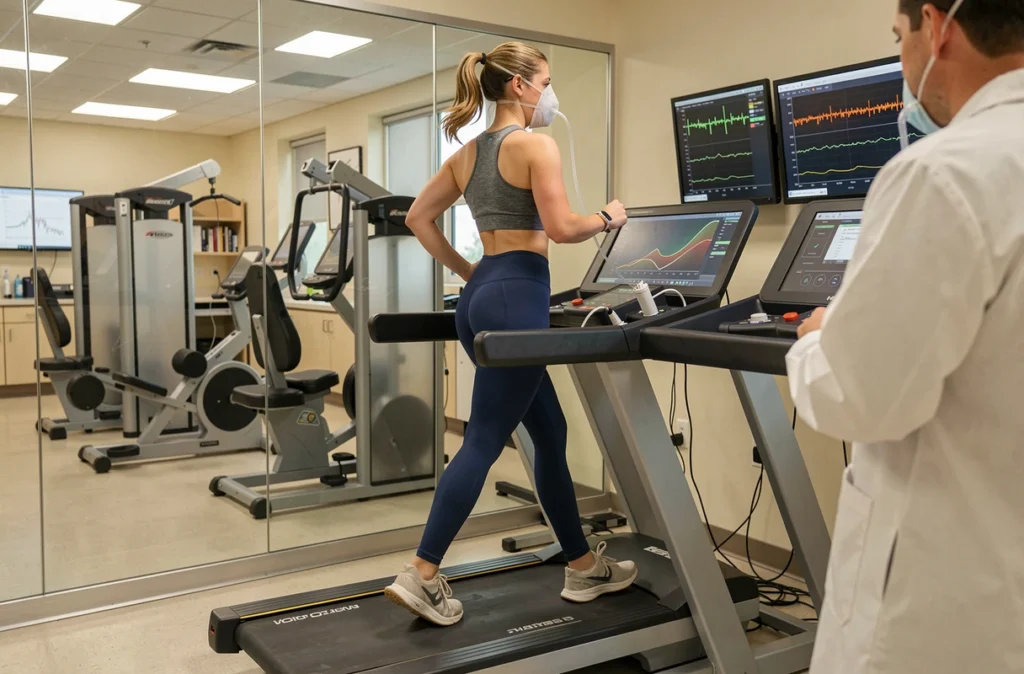
The physical assessment identifies these motor control deficits. Simple proprioceptive tests (single-leg balance, controlled landing, direction changes) are enough to spot the weaknesses. A meta-analysis published in August 2026 confirms that neuromuscular and proprioceptive programs significantly reduce the risk of injury for athletes who integrate them into their routine.
Three markers to monitor during the assessment
- The ankle stability in single-leg support: a low hold time or marked oscillations indicate a proprioceptive deficit affecting the entire posterior chain
- The strength ratio between agonist and antagonist muscles, particularly at the knee and shoulder, two areas where imbalances cause the majority of chronic injuries
- The quality of the single-leg squat pattern: if the knee deviates inward (dynamic valgus), the ligament risk increases with each training session
These markers do not require expensive equipment. A sports physiotherapist or qualified strength and conditioning coach can evaluate them in a single session.
Adapting the physical assessment to your discipline and age
A useful assessment is not a standardized one. A cyclist does not have the same joint constraints as a handball player. A 25-year-old athlete does not present the same risks as a 55-year-old who is returning to competition.
For endurance sports (running, cycling, swimming), the analysis focuses mainly on the efficiency of repetitive movement, cardiorespiratory capacity, and postural imbalances related to hours of identical movement. A runner who accumulates kilometers without correcting an asymmetrical stride exacerbates the problem with each outing.
For team sports or racket sports, the assessment targets more muscle reactivity, direction change capacity, and resistance to sudden movements. The constraints are explosive and multidirectional, which stresses the joints differently.
The particular case of athletes over 40
With age, recovery slows down and tendons lose elasticity. The assessment then becomes a dosing tool. It allows for setting realistic load thresholds rather than applying training volumes designed for younger bodies.
From a regulatory standpoint, the French framework has evolved. A medical certificate is no longer systematically required to obtain or renew a sports license since the 2021-2022 reform. For minors, a health questionnaire replaces it in most cases. Disciplines classified as “with particular constraints” still require a medical certificate dated within the last year. This distinction should be verified before any club registration.
Utilizing the assessment results to structure training
The assessment is only valuable if it changes what you do next. Too many athletes undergo tests, receive a report, and then follow exactly the same program. The goal is different: to translate each result into targeted training action.
If the assessment reveals a hip mobility deficit, integrate joint mobility exercises before each session, not after. If ankle stability is insufficient, add two proprioceptive sessions per week for six to eight weeks before re-evaluating.
- Plan a new assessment every three to four months to measure progress and adjust priorities
- Share the results with your coach or strength and conditioning coach to ensure the plan aligns with your actual capabilities
- Note your feelings (fatigue, pain, sleep quality) between assessments to contextualize the objective data
The sports physical assessment functions like a mechanical diagnostic on a racing car. Without it, you drive blind. With it, you know exactly where to invest your energy so that each session counts.