
A step-by-step planner is not just an agenda with checkboxes. The difference lies in the granularity: each goal is broken down into dated micro-steps, transforming a vague intention into a sequence of concrete actions. We recommend treating the planner as a management tool, not just a simple memory aid.
Structuring a hybrid paper-digital system for your planner
The majority of guides still oppose paper planners and digital planners. However, the market has shifted towards hybrid systems combining handwritten journaling and cloud synchronization. This approach leverages the cognitive benefits of handwriting (deeper encoding, better retention) while maintaining the flexibility of digital for reminders and sharing.
The principle is based on three complementary layers. Capture occurs on paper, in a dedicated notebook or physical planner. Weekly centralization migrates these notes to a connected calendar. The third, more recent layer uses an AI assistant to suggest reorganization of the schedule based on postponed tasks or available time slots.
In practice, we observe that paper capture works better for creative tasks or personal goals, while the digital aspect excels in managing shared deadlines and collaborative projects. Combining the two avoids the pitfalls of a fully paper-based system (no automatic reminders) and a fully digital one (disruptive notifications, tool overload).
To structure this system, a tool like My Babysteps Planner allows you to break down each goal into progressive steps, facilitating the transition between handwritten capture and digital planning.
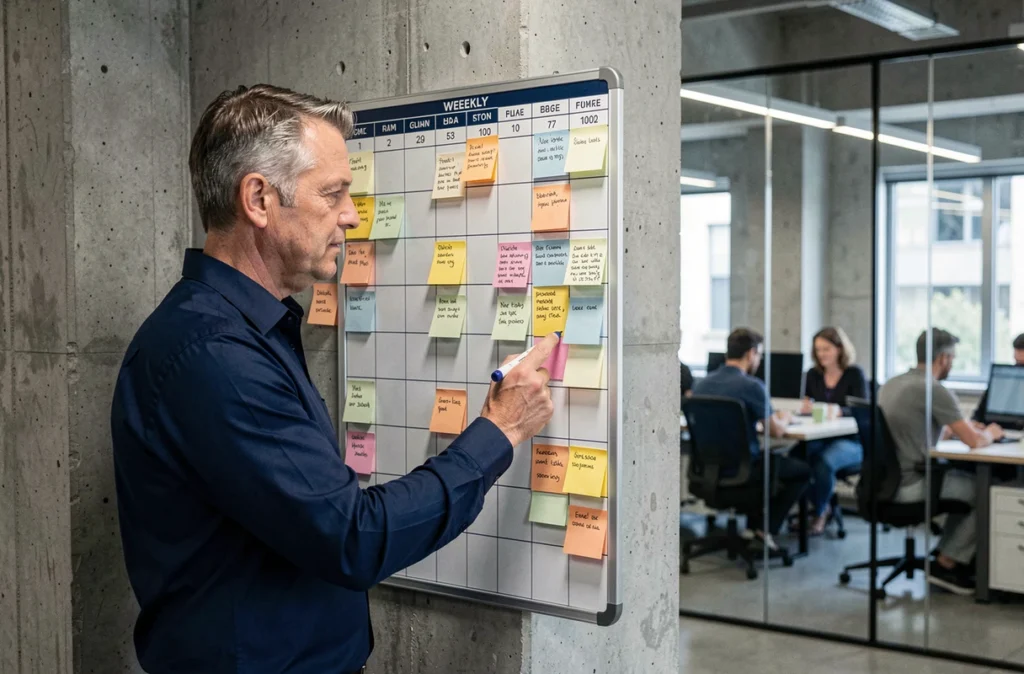
Breaking tasks into dated micro-steps in a planner
Most organizational failures stem from a problem of granularity. Writing “finalize project X” in a planner has no operational effect. Each task must be broken down until it can be executed in less than thirty minutes.
This granularity imposes precise discipline at the planning stage. We recommend formulating each micro-step with an action verb, an identifiable deliverable, and a deadline. “Write the introduction of the report” is actionable. “Make progress on the report” is not.
Decomposition method for a step-by-step planner
The process follows a top-down logic:
- Identify the goal for the week (one measurable outcome per life domain: work, personal, health).
- List the necessary intermediate deliverables to achieve this goal, in chronological order.
- Assign each deliverable to a specific day, considering available time slots and your expected energy level.
- Allow for a buffer: block an empty slot at the end of the week to absorb delays without blowing up the schedule.
This breakdown transforms the task list into a manageable sequence. The planner becomes a dashboard where each checked box corresponds to real progress, not a reformulated intention.
Weekly review and schedule adjustment
A planner without regular review becomes a graveyard of good intentions. The weekly review is the mechanism that keeps the system alive. It lasts between fifteen and twenty-five minutes and ideally takes place on Sunday evening or Friday at the end of the day.
Three operations structure this review. First, the factual assessment: how many micro-steps were completed, how many postponed, how many abandoned. This ratio provides an accurate picture of your actual production capacity over the past week.
Next, the analysis of postponements. A task postponed twice in a row signals a problem with granularity (step too broad), motivation (task poorly aligned with your goals), or overload. Identifying the cause of the postponement before re-planning helps avoid repeating the same pattern the following week.
Calibrating your actual load in the planner
Overplanning is the most common trap. We observe that most users overestimate their weekly capacity by at least one third. The fix is simple: after three weeks of use, calculate your average number of micro-steps actually completed per day. This number becomes your planning ceiling.
Planning below your maximum capacity leaves room for the unexpected and reduces frustration. A realistic planner, filled two-thirds full, produces better results than a saturated planner that generates guilt.

Using AI as an optimization layer for the planner
AI assistants integrated into office suites are beginning to change the way we interact with a digital planner. Their main contribution lies not in creating tasks, but in dynamically reorganizing the schedule based on real constraints.
An assistant can analyze your postponed tasks, identify underutilized time slots, and suggest a rearrangement. Some experiments show that entrusting the reorganization of your schedule to an AI tool for a week yields surprising results in terms of prioritization, even though human judgment remains necessary to validate choices.
AI does not replace the weekly review. It feeds into it. Before your assessment session, asking an assistant about recurring patterns in your week (which tasks are consistently postponed, which days have the most delays) speeds up diagnosis and makes adjustments more precise.
Concrete limits of AI-assisted planning
AI does not manage emotional context or implicit priorities. It may suggest placing an administrative task at 8 AM because the slot is free, without knowing that you are more productive on creative tasks at that hour. The planner remains a tool for human decision-making, not delegation.
The best practice is to use AI as a planning reviewer, not as an autonomous planner. You validate, modify, or reject each suggestion before it enters your week.
A well-calibrated step-by-step planner rests on three pillars: a fine enough breakdown to be actionable, a regular enough review to correct the trajectory, and a realistic enough load to be sustainable over time. The format (paper, digital, or hybrid) matters less than the rigor of the accompanying process.