
Gabrielle Cluzel occupies a unique place in the French media landscape: editor-in-chief of Boulevard Voltaire, a regular commentator on the airwaves, and author of several works, she speaks on family, education, and politics with a consistency that contrasts with common reversals. Her marriage and married life, however, remain a deliberate blind spot in her public communication.
Gabrielle Cluzel and the radical separation between public life and married life
No verified information circulates about Gabrielle Cluzel’s husband. No confirmed first name, no documented profession, no published photo with his consent. This opacity is not accidental: it stems from a carefully constructed posture maintained over several years, in contrast to the trend of media personalities to instrumentalize their couple as a narrative device.
We regularly observe, in the sphere of conservative editorialists, a recourse to family narratives as proof of ideological coherence. Gabrielle Cluzel makes the opposite choice. The silence about her partner functions as an act of intellectual coherence, not as a lack of transparency.
This posture has generated a significant volume of queries around the expression “husband of Gabrielle Cluzel.” Some searches even associate the name Jean-Paul Cluzel, former head of Radio France, with the journalist, a confusion of homonymy without any factual basis. This misunderstanding has been explicitly classified as misinformation by several analysis sites. In exploring Gabrielle Cluzel’s marriage and her husband, one can measure the gap between public curiosity and documentable reality.
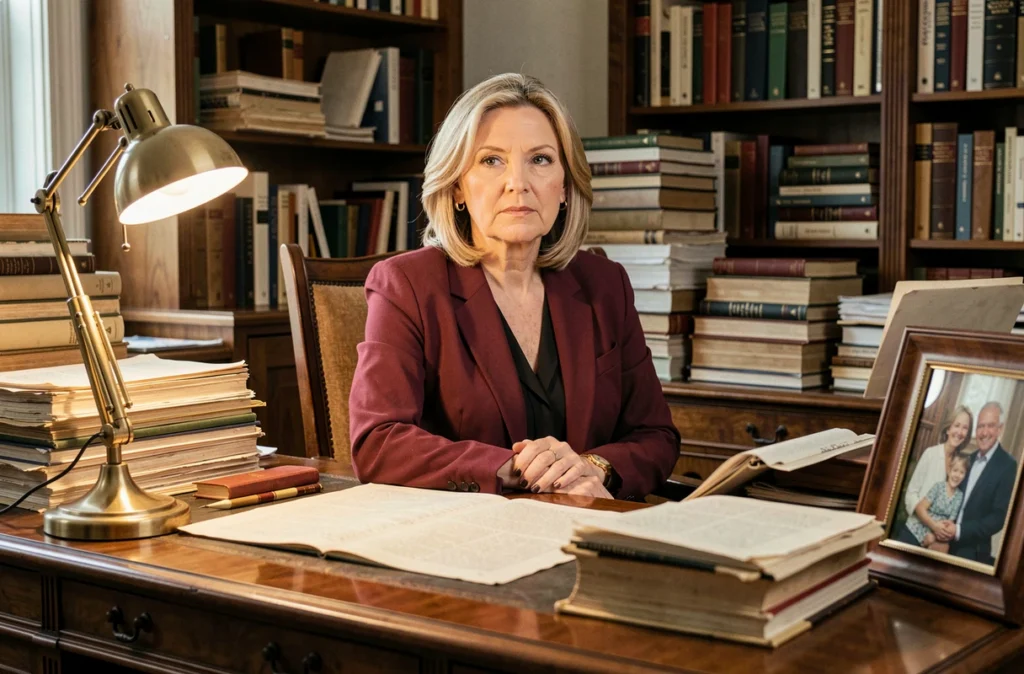
Gabrielle Cluzel’s vision of family: lineage, motherhood, transmission
Gabrielle Cluzel does not theorize family in the abstract. Her positions are rooted in concrete issues: French natalist policy, the reform of retirement pensions for mothers, the role of schools in transmitting values.
On Boulevard Voltaire, she has defended a direct demographic reading by asserting that the remedy to the “great replacement” would be “great childbirth,” a phrase that condenses her natalist vision. Motherhood is presented as both a political and personal act.
Her critique of the reform of retirement pensions for mothers, which she describes as “charity” or even a “Jarnac blow,” illustrates a precise positioning. The issue is not only economic: it touches on the symbolic recognition of the maternal role in French society. For Cluzel, any reform that diminishes mothers’ contributions to demographics undermines the foundations of the family unit.
Five generations and the notion of lineage
An episode relayed by Famille Chrétienne shows Gabrielle Cluzel surrounded by five generations of the same family, presented as “a blessing.” This type of intergenerational staging is not insignificant in her discourse. The family is not an isolated conjugal unit but a chain of transmission that spans the ages.
This vision goes beyond the couple. It implies an educational, religious, and cultural continuity that modernity, according to Cluzel, jeopardizes through the atomization of family ties.
Gabrielle Cluzel, religious convictions, and media engagement in France
Gabrielle Cluzel’s Catholicism is not a discreet background. It structures her interventions on the place of religion in public space, the defense of persecuted Christians, and the critique of militant secularism.
On the issue of vandalized churches in France, she expressed an unambiguous position: “The victims are the Christians.” This statement falls within a denunciation of what she perceives as a double standard in the media treatment of attacks on places of worship.
- Defense of the school as the “mother of battles” for the transmission of values, with a strong critique of what she calls the ideological locking of public schools by the far left.
- Frontline opposition to the normalization of polygamy, documented by her columns on Boulevard Voltaire regarding statements from LFI activists.
- Support for the Pope’s visit to France in the face of secularist criticisms regarding public funding, particularly during the Metz episode.
The coherence between her religious convictions and her political positions forms the foundation of her credibility with her readership. She does not compartmentalize: faith informs political analysis, and political analysis nourishes the defense of faith.

Political marriage and partisan alliances: the metaphor according to Cluzel
Gabrielle Cluzel also uses matrimonial vocabulary to analyze French political life. Her phrase “sadomasochistic marriage” to describe the PS/LFI alliances in the 2026 municipal elections illustrates a recurring rhetorical device: borrowing from the family register to disqualify coalitions she deems unnatural.
This semantic shift is not gratuitous. It connects two axes of her thought. On one side, marriage as a sacred institution, based on complementarity and duration. On the other, partisan alliances as parodies of this model, built on opportunism and ideological submission.
Marriage for Cluzel functions as a moral benchmark against which she measures the sincerity of commitments, whether marital or political. The metaphor is never innocent: it assumes that the traditional conjugal model remains the reference, even for judging the solidity of an electoral coalition.
Private life, media order, and family honor in 2026
Gabrielle Cluzel’s refusal to reveal her married life takes on particular significance in the media context of 2026, where the boundary between private sphere and public exposure is diminishing. Social media, testimonial shows, political storytelling—all push towards self-staging.
Cluzel resists this pressure. Her choice to protect the identity of her husband and children constitutes, in her logic, an act of preserving family honor against media voracity. This discretion does not weaken her discourse on family: it strengthens it, showing that public speech about the couple does not need exhibition to be credible.
For an editorialist who has made family the center of gravity of her thought, this voluntary restraint says more about her vision of marriage than any confidence could.