
A string trimmer spins at several thousand revolutions per minute, projecting a nylon line at high speed and cutting grass by impact. The principle seems simple, but the result depends as much on the diameter of the line chosen as on the power of the motor driving it. Poorly matched, these two parameters can cause overheating, repeated line breakage, or mediocre finishes. Understanding this line-motor coupling is what separates a clean edge from a frustrating afternoon.
Line Diameter and Motor Power: The Coupling Ignored by Manuals
The cutting head of a string trimmer spins a nylon line whose diameter varies according to the models. This line cuts grass through centrifugal force, not by a sharp edge. The thicker the line, the more resistance it offers to air and vegetation, and the more torque the motor must provide to maintain speed.
The problem arises when the line diameter does not match the available power. A line that is too thick mounted on a small electric trimmer causes a drop in speed and overheating of the motor. The device seems to operate, but the clutch or electronics wear out prematurely. Conversely, a line that is too thin on a powerful device breaks constantly and loses all effectiveness as soon as the grass becomes a bit dense.
To delve deeper into the operation and use of a string trimmer, one must first think in terms of matching these two parameters rather than looking for the thickest line or the most powerful motor.
| Type of String Trimmer | Common Power Range | Recommended Line Diameter | Typical Use |
|---|---|---|---|
| Wired Electric | Low to Medium | Thin Line (around 1.6 mm) | Small Edges, Regularly Maintained Lawn |
| 18 V Battery | Medium | Thin to Medium Line | Modest Sized Garden, Finishing After Mowing |
| 36-40 V Battery | Medium to High | Medium to Thick Line | Full Garden, Edges and Slopes in One Session |
| Gas-Powered | High | Thick Line or Blades | Large Areas, Tall Grass, Overgrown Land |
This table highlights a logic often overlooked: the line diameter is chosen after the power, never before. Mounting a brushcutter line on an 18 V battery trimmer is like asking a city motor to tow a trailer.

36-40 V Batteries: The String Trimmer That Changes Maintenance Sessions
Older generations of battery-powered string trimmers required frequent recharging breaks. A standard 18 V battery rarely lasted more than fifteen minutes of continuous use, which fragmented the work and extended the maintenance chore.
The 36-40 V high-capacity platforms have changed the game. They now allow you to cover an entire garden in a single session: lawn edges, under fences, around tree bases, slopes. For an individual with a medium-sized yard, recharging during work is no longer necessary.
This increased autonomy has an indirect effect on the quality of the result. When the energy decreases, the motor speed drops, the line loses rotational speed, and the cut becomes uneven. With a battery that lasts the entire session, the speed remains constant from the first to the last meter of edge.
- Inter-tool compatibility is a tangible advantage: the same 36 V battery can power a string trimmer, hedge trimmer, and blower, reducing the overall cost of equipment.
- The weight of the battery is concentrated in the handle or at the waist depending on the models, which changes the balance of the device and merits a trial before purchase.
- The full charging time of a high-capacity battery often exceeds one hour, a point to anticipate if you forget to plug it in the night before.
Cutting Technique with a String Trimmer: Angle and Sweeping Motion
A poorly held string trimmer produces an uneven result, even with the right line and power. The cutting head must remain tilted at a constant angle to the ground, never coming into direct contact with the soil. Touching the ground accelerates line wear and digs grooves in soft soils, especially sandy ones.
The effective movement is a slow lateral sweep, from left to right for a right-handed person, allowing debris to fall back onto the already cut area. Moving too quickly forces the line to work in a mass of grass that is too dense, causing tearing instead of clean cuts.
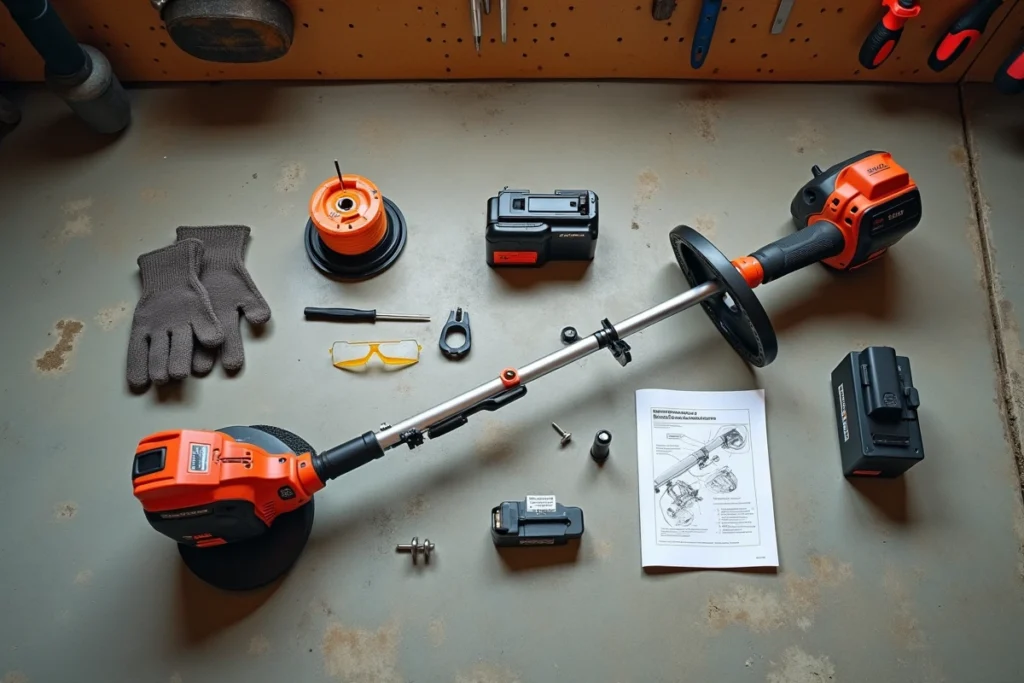
Around trees and young plants, the main risk is bark stripping. The nylon line at full speed can cut into the bark in seconds, which can compromise the growth of a tree for several seasons. Protective sleeves are available for young trunks and represent a minimal investment compared to the cost of a replaced tree.
Maintenance of the Line and Cutting Head: What Wears Out First
The nylon line degrades over time, even without use. Exposed to heat and UV, it becomes brittle and loses flexibility. A line stored for several seasons in a garden shed that overheats in summer breaks twice as fast as a new line.
Soaking the line in water for a few hours before use restores its flexibility and reduces breakage. This is a simple trick that significantly extends the lifespan of each spool.
The cutting head itself deserves regular inspection. Automatic feed systems (tap-and-go) can jam when grass debris accumulates inside. A quick cleaning after each use, by removing the spool cover and blowing out debris, prevents blockages during the session.
- Check the condition of the line exit eyelet: a worn or chipped eyelet cuts the line prematurely with every contact.
- The protective guard must remain in place. It limits the length of active line and protects the user from flying stones or debris.
- On gas-powered models, the air filter and spark plug condition the motor speed and thus the quality of the cut.
The string trimmer remains the most versatile finishing tool for a garden, provided the line-motor coupling is respected and a steady motion is maintained. A line suited to the power and a battery that lasts the entire session are enough to transform a chore into a quick and clean pass along edges, fences, and flower beds.