Maternity in France is undergoing a period of profound changes. Behind the carefully curated aesthetics and product selections, economic, regulatory, and professional realities are reshaping the daily lives of mothers. Understanding these developments allows us to grasp what is truly changing for modern moms in 2025-2026.
Maternal penalty and women’s careers: the real underlying issue
The High Council for Equality (HCE) has dedicated a report to the socio-economic impact of maternity. The conclusion is clear: becoming a mother is still associated with a loss of income and a slowdown in career progression that fathers do not experience to the same extent. The term maternal penalty refers to this structural gap.
The issue goes beyond maternity leave itself. Returning to work, access to promotions, flexible hours: each stage has specific barriers. For self-employed individuals and freelancers, maternity leave coverage remains a separate issue, with disparities depending on their status.
This factual framework highlights a paradox: maternity trends promote a fulfilling lifestyle, while available data shows that maternity deepens professional inequalities between women and men. Modern moms navigate this reality, often without mainstream media documenting it beyond raw numbers.
Several media outlets closely follow these developments, and the updates on happymaman.fr regularly compile news affecting parental daily life.

Birth budget and cost of the first year: significant figures
The first year of a child’s life represents an average budget of 6,172 euros for French families. Diapers, childcare, baby products: expense categories accumulate quickly.
This amount does not account for comfort purchases or trendy products. It covers basic needs. For families wishing to invest in eco-friendly brands, made in France products, or connected accessories, the bill increases.
A barrier to having a second child
A survey by the Family Observatory (Unaf), published in September 2026, provides additional insight: 67% of parents report not having sufficient means to have an additional child. This barrier is particularly pronounced among women and young parents.
The economic tension surrounding parenthood is not new, but it is becoming clearer as surveys document families’ feelings. Current trends for moms, whether in fashion, baby products, or well-being, exist within a context where every expense is scrutinized.
Support for young parents: what the law has changed since 2025
Under the full employment law of December 18, 2023, all French municipalities have, since January 1, 2025, an obligation to inform and support families with a child under three years old. This system includes a section dedicated to maternal mental health.
On the ground, implementation varies by locality. Some municipalities have developed structured pathways with parenting referents, while others limit themselves to directing families to existing services. Feedback from the field varies on this point, and it will take time to assess the actual effectiveness of the system.
This regulatory framework marks a change in approach. Parenthood is no longer just a private matter: it becomes a local public policy issue, with concrete obligations for elected officials.

Butter mom trend and new maternal aesthetics on social media
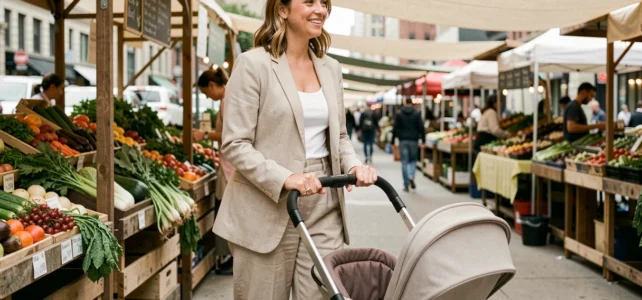
In terms of style, the butter mom trend has emerged on TikTok and Instagram, driven by millennials and Generation Z. The principle: a relaxed approach to parenting, blending educational kindness and a warm aesthetic. Soft tones, comfortable materials, staging a calm daily life.
This trend is part of a broader movement to reclaim the maternal image. Modern moms no longer seek to conform to a single model. The chic mom style coexists with minimalist, sporty, or engaged approaches.
What these trends reveal
Maternal aesthetics on social media function as identity markers. They reflect consumption choices (quality products, ethical brands, second-hand) as well as educational stances. However, they tend to smooth over the real difficulties of motherhood, which economic and social data document elsewhere.
Maternity fashion collections, new breastfeeding products, and designer baby accessories respond to a demand for quality and style. The diaper bag has become a fashion item. Nursing clothes are approaching classic ready-to-wear. These developments are real, but they only concern a portion of moms, those whose budget allows it.
Parenthood and mental health: a still under-documented angle
The HCE report points to a rising issue: the impact of maternity on women’s mental health. Burnout, mental load, postpartum isolation—these realities are increasingly being named.
The need for psychological support far exceeds the available supply. The municipal system established in 2025 attempts to address this, but the resources allocated vary significantly from one area to another.
Current trends for modern moms are not limited to gift ideas or Instagram looks. They touch on structural issues: purchasing power, professional equality, access to care, public support. Recent legislative changes are slowly redefining the concrete conditions of maternity in France.