
A domestic cat retains many of the behaviours inherited from its wild ancestor, the African wildcat. Understanding a cat’s needs starts with accepting that it remains a territorial predator, solitary by nature, whose wellbeing depends on having control over its environment. This perspective guides every decision, from choosing a litter tray to managing a house move.
Territorial behaviour in cats: the foundation of any home setup
Cats organise their space into distinct functional areas: a resting area, a feeding area, a toileting area, and an area for play or hunting. These areas should be physically separate to prevent chronic stress, which can lead to house-soiling, urine marking or excessive grooming.
For example, never place the litter tray next to the food bowl. The exact distance between them matters less than one simple rule: the cat should not be able to see one from the other. In a small flat, a room divider or hallway is enough.
This spatial organisation also explains why cats with outdoor access develop regular patrol routes. Suddenly removing a cat from this routine—for example, during a house move—is like taking away its territory. The behavioural response is almost inevitable: night-time meowing, scratching and even temporary loss of appetite.
To explore this topic further and adapt your cat’s daily routine, Animaloo’s advice on cats covers a wide range of real-life situations.
Feeding your cat: animal protein and feeding schedules

Cats are obligate carnivores. Their bodies cannot synthesise certain amino acids (taurine, arginine) or vitamins (A, D) from plant-based precursors. A diet deficient in animal protein can eventually cause heart or retinal problems.
Choosing between dry food and wet food is about more than taste. Wet food provides more moisture, which reduces the strain on the kidneys. Dry food, meanwhile, helps mechanically scrape away dental tartar. Alternating between the two provides a broader range of benefits than feeding only one type.
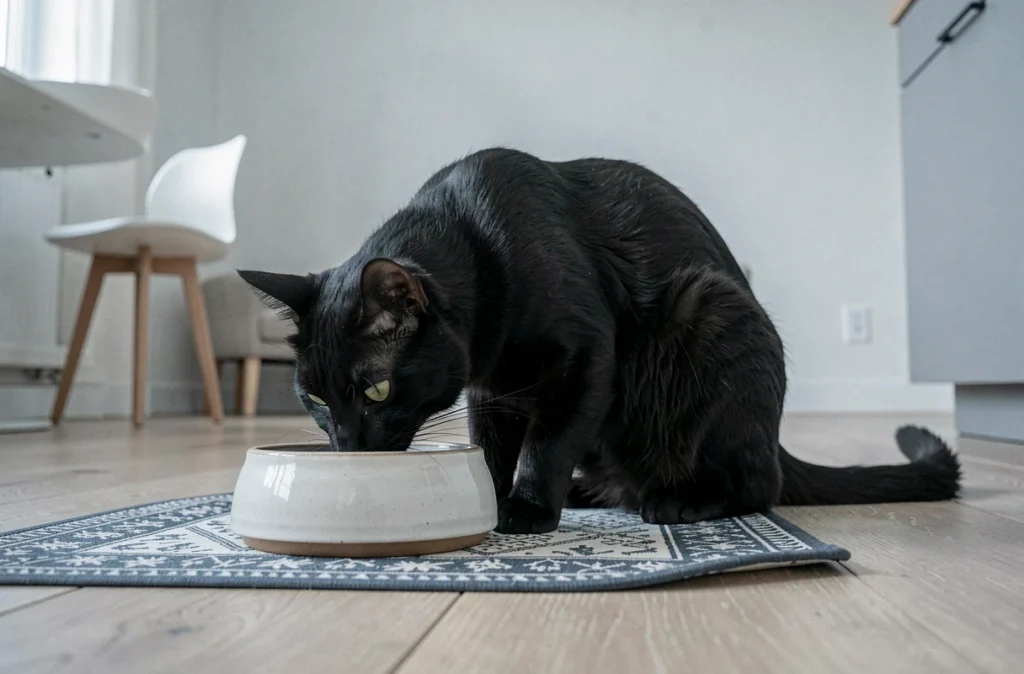
Feeding frequency matters just as much as the food itself. Leaving dry food out for free feeding and adding one or two portions of wet food at set times follows a split-feeding pattern closer to a cat’s natural eating habits. Feeding two meals a day, as you would a dog, can cause frustration and encourage overeating.
- Check that the ingredient list starts with a named animal protein source (chicken, salmon, turkey), not grains or plant by-products.
- Adjust the amount to your cat’s age, weight and activity level: a neutered indoor cat needs significantly fewer calories than an active cat with outdoor access.
- Place the water bowl away from the food, as many cats drink more when their water source is in another room.
Signs of stress in cats: spotting distress before it takes hold
Cats do not show pain or anxiety in obvious ways. Excessive grooming is often the first visible sign, with patches of hair loss appearing on the belly or flanks. This behaviour often goes unnoticed because it looks like normal grooming.
Other signs are worth watching for. A cat that stops playing, hides for long periods or suddenly changes its eating habits is showing signs of discomfort. House-soiling, often mistaken for defiance, is in most cases a sign of pain (cystitis, constipation) or territorial conflict with another pet in the household.
Consulting a vet as soon as a lasting change in behaviour appears helps rule out a medical cause before you make changes to the cat’s environment. Blood and urine tests are usually enough to guide the diagnosis.
Supporting your cat’s wellbeing when your life changes
A house move, the arrival of a baby, a change in work schedule or a separation can alter a cat’s environment without giving it any control over the situation. This is precisely the kind of scenario that is most unsettling for an animal whose wellbeing depends on predictability.
When moving house, set up the cat’s belongings in one room before opening up the rest of the home to limit sensory overload. Keeping the litter tray, food bowl, scratching post and bed together in an enclosed space for two to three days gives the cat time to establish an initial territorial base. It can then explore the rest of the home at its own pace, one room at a time.
When a change means the owner will be away for an extended period (hospitalisation, a long business trip), you’ll need to arrange care. Leaving the cat with someone it already knows reduces the stress of the transition. If that isn’t possible, having a pet sitter visit the cat at home is preferable to boarding, as staying in familiar surroundings partly makes up for the absence of its human companion.
- Arrange care before an emergency arises: leave a note with the cat’s routine (feeding times, food brand, litter tray location and regular vet’s name).
- Leave a worn item of clothing near the cat’s bed. Familiar scents have a documented calming effect in feline behavioural medicine.
- Avoid making several changes at once: moving house is not the time to introduce a new type of litter or a second pet.
Cat identification: a legal requirement that is often overlooked
Microchipping is compulsory in France for all cats over the legal age. Yet many owners are unaware of this requirement, making it harder to reunite lost cats with their families and slowing the work of shelters, which are already struggling with limited capacity.
Identification is not just for finding a lost cat. It also serves as legal proof of the relationship between the animal and its owner, making things easier in the event of a dispute, theft or emergency placement following an unexpected change in circumstances.
Whenever a kitten is transferred to a new owner, whether sold or given away, a veterinary certificate issued within the previous three months is one of the required documents. Checking these formalities protects both the person transferring the kitten and the adopter.
A cat’s wellbeing depends less on how many accessories you buy than on how well its environment meets its biological needs. A stable territory, a diet suited to its carnivorous physiology, and an owner who notices subtle signs of stress provide a foundation that even major life changes need not undermine—provided you plan ahead.